Sustainability is not just a nice-to-have
Sustainability is becoming a bigger part of how travellers choose where to go, what to book, and which operators they feel good supporting.
For long-haul destinations like Australia and New Zealand, this matters even more. International travellers are often travelling a long distance, and many want to know that the experiences they choose are supporting the places, cultures, communities, and environments they have come to see.
Tourism Australia’s Green is Our Gold initiative has brought this conversation into sharper focus, encouraging the industry to get behind a shared commitment to responsible tourism and the protection of Australia’s natural places, cultures, communities, wildlife, and visitors. Its research also shows that sustainability is increasingly important to international travellers, both in everyday life and in travel decisions.
For tourism operators, the opportunity is simple: if you are already doing good work, make sure guests can see it.
Many operators are already contributing to sustainability in practical ways, but sometimes those efforts are not clearly visible in the customer journey.
A guest may browse your product, compare options, and make a booking without ever seeing the sustainability work behind the experience. That is a missed opportunity, especially when travellers are looking for reassurance that their booking supports responsible tourism.
Tourism Australia’s Green is Our Gold initiative is a timely reminder for operators to review how they communicate these efforts and whether their sustainability story is visible at the moments guests are making decisions.
Make your sustainability commitment easy to find
If your business has a sustainability accreditation, certification, eco badge, or recognised program membership, it is worth reviewing where that information appears.
Consider whether guests can easily see it on:
- Product pages
- Booking pages
- Confirmation emails
- Pre-arrival emails
- Website content
- Brochures or trade materials
- Partner or reseller listings
The goal is not to overload guests with information. It is to make your sustainability commitment easy to recognise at the right moment.
For Cobber clients, you may speak with your Customer Success Manager about ways to share your sustainability story through customer-facing content, such as tour descriptions, supporting notes, or automated follow-up emails.
Know where to start
For Australian operators, Tourism Australia’s Green is Our Gold initiative is a useful place to start. It invites you to take part in a shared commitment to sustainable tourism through the Green and Gold Promise.
The initiative includes practical tools and guidance built around five Green and Gold Principles: Celebrate Community, Embrace Culture, Preserve Place, Respect Wildlife, and Take Care.
If you want to explore sustainability further, Tourism Australia also has a sustainable tourism resource page with guidance around getting started, becoming assessed or certified, and sharing sustainability stories clearly. It points operators to programs such as Sustainable Tourism Accreditation, emissions reduction pathways, Ecotourism Australia, EarthCheck, and other certification options.

For New Zealand operators, Qualmark is New Zealand tourism’s official mark of quality and includes evaluation against Sustainable Tourism Business Standards. The New Zealand Tourism Sustainability Commitment also encourages tourism businesses to work towards sustainability across economic, visitor, community, and environmental outcomes.

Be clear, accurate, and confident
Sustainability messaging should be easy to understand, but it also needs to be accurate, specific, and backed by evidence.
If your business uses words like “eco-friendly,” “sustainable,” or “green” across your website, brochures, booking platforms, product pages, partner listings, or social media, make sure those claims clearly explain what you are doing and how you can prove it.
This matters more when targeting international travellers. A QTIC and EarthCheck factsheet notes that the EU found more than half of green claims reviewed were vague or misleading, with nearly 40% lacking supporting evidence. From 27 September 2026, Europe’s Empowering Consumers Directive applies to businesses marketing to consumers in EU countries, including businesses outside Europe.
In Australia, the ACCC has also issued greenwashing guidance and taken action against unsubstantiated environmental claims. The message is simple: if you make a sustainability claim, you need to be able to prove it.
Tourism Australia’s Green is Our Gold initiative is a useful prompt to make your sustainability story credible, specific, and compelling for international travellers.
A great example from the Reef
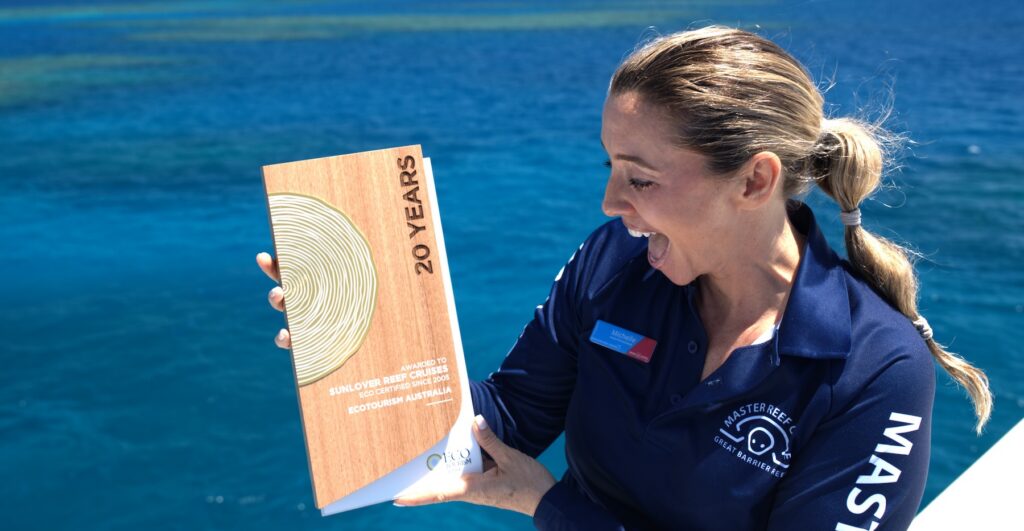
For operators like Sunlover Reef Cruises, sustainability accreditation represents far more than a logo or badge. It reflects decades of commitment to protecting the destination their experiences rely on, while continuing to deliver world-class guest experiences on the Great Barrier Reef.
Sunlover Reef Cruises holds Ecotourism Certification through Ecotourism Australia and is recognised by the Great Barrier Reef Marine Park Authority as a High Standard Tourism Operator. The company was named a Green Travel Leader at its 10-year milestone and has since been inducted into the Ecotourism Australia Hall of Fame, marking more than two decades of continuous certification.
“For Sunlover, eco certification has never been an end goal or a box to tick, it’s a partnership that keeps us moving forward,” said Michelle Barry, Master Reef Guide at Sunlover Reef Cruises.
“After more than 20 years of continuous certification, we’re still using it to challenge ourselves, taking up new science and technology, and getting leaner and lighter with our footprint year after year. The reef has been our home for over three decades, and protecting it has always meant protecting the wider planet it belongs to. That’s a responsibility our whole team carries every single operating day.”